Surplus Food
Edible food can be redirected, preserved, or transformed before it becomes waste.
Food upcycling turns safe surplus food, food by-products, and overlooked ingredients into useful products with environmental, social, and economic value.
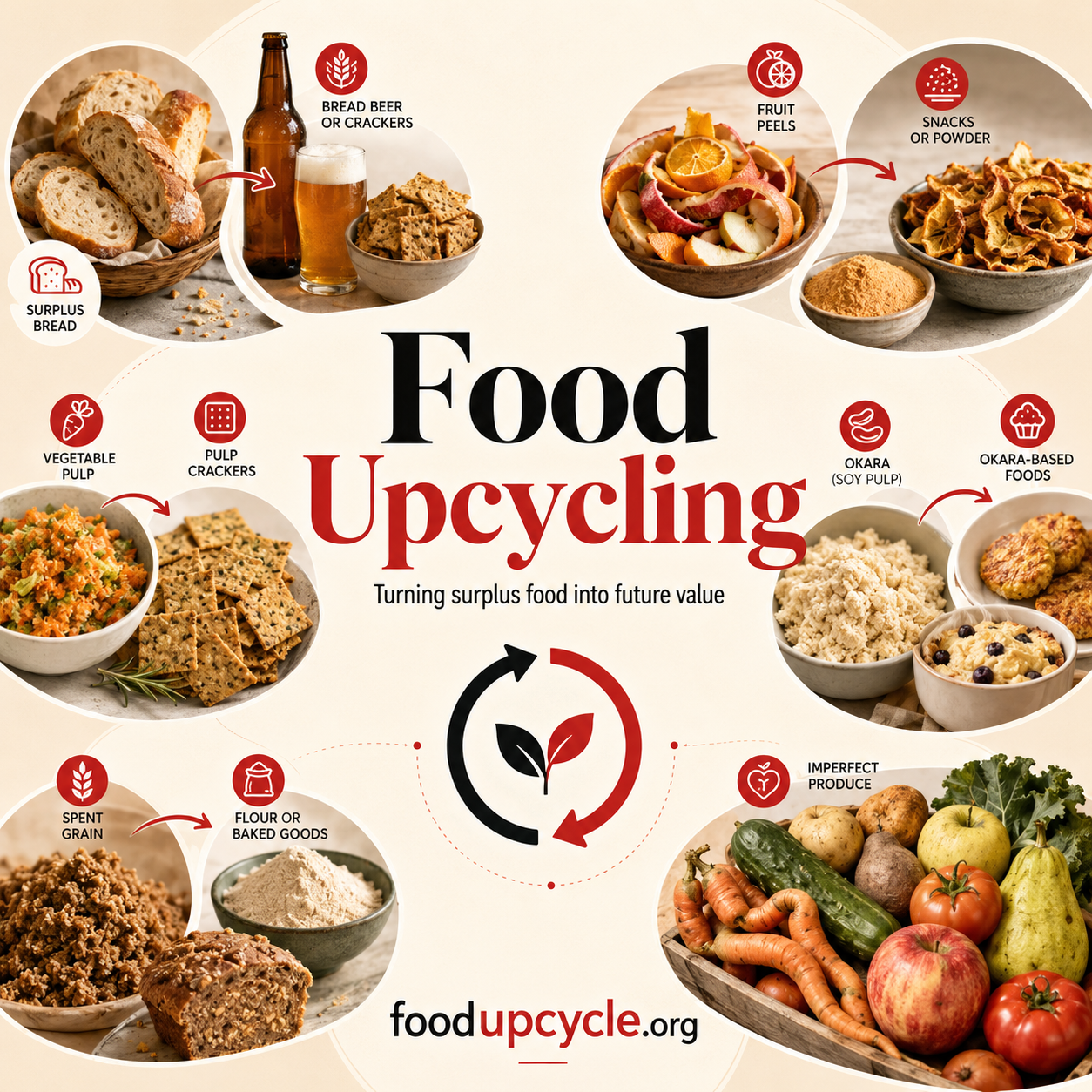
Food upcycling is not an excuse to waste food. It is a practical way to recover value from safe materials that would otherwise be underused or discarded.
Edible food can be redirected, preserved, or transformed before it becomes waste.
Peels, pulp, spent grain, okara, and similar materials can become ingredients when handled safely.
New foods, powders, baked goods, snacks, compost links, and local enterprises can emerge from circular thinking.
A good upcycling process is organized, safe, traceable, and useful for real people.
Map surplus food, imperfect produce, and side streams from processing.
Check safety, consistency, nutrition, volume, traceability, and possible uses.
Use suitable drying, chilling, freezing, milling, fermenting, or extraction methods.
Create useful products such as flour, snacks, sauces, beverages, or bakery ingredients.
Test quality, shelf life, labeling, consumer acceptance, and environmental value.
The strongest examples are easy to understand: a safe material is collected, stabilized, tested, and transformed into something people can use.
These pathways can support food innovation, community education, small businesses, and circular economy research.
Creates new or higher-value products from safe surplus food, by-products, or underused ingredients.
Recovers materials or nutrients into another usable form, often with less focus on food product innovation.
Converts unavoidable organic residues into compost that can support soil health and agriculture.
Creativity cannot replace food safety. If a material is spoiled, contaminated, or unsuitable for food use, it should not be upcycled into food.
Trust grows when the product story, processing method, safety checks, and labeling are clear.
Food upcycling connects households, businesses, researchers, educators, and policymakers.
Plan meals, store food well, use leftovers creatively, and support trustworthy upcycled products.
Map side streams, test product ideas, reduce disposal costs, and create new value chains.
Study safety, nutrition, processing methods, shelf life, consumer acceptance, and impact.
Support clear guidance, food safety standards, circular procurement, and local innovation.
FoodUpcycle.org presents food upcycling as a practical sustainability tool and a research field for circular food systems.